
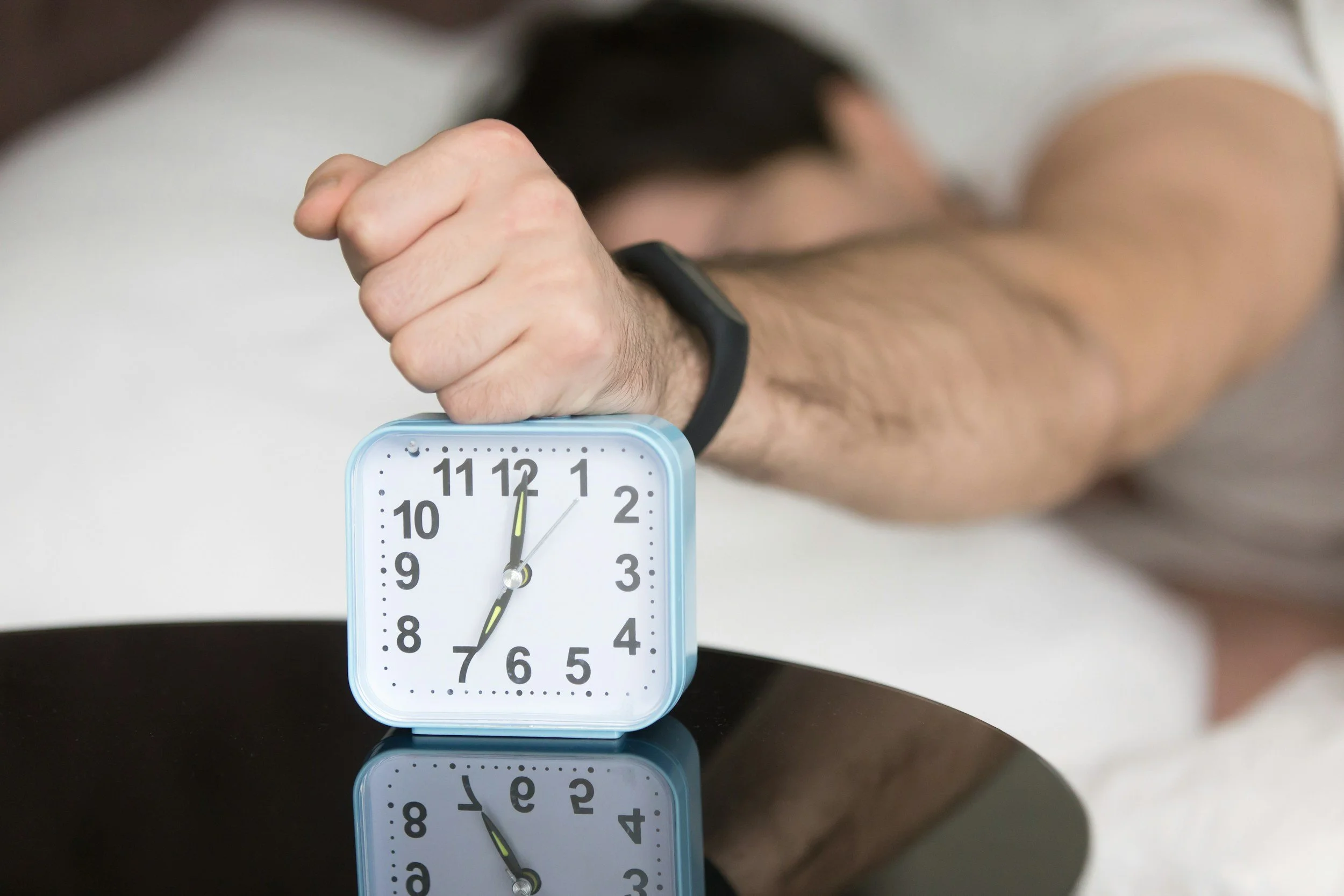
If you read my last blog about ADHD sleep problems, you already know that sleep and ADHD can be a complicated relationship. For many ADHDers, the problem doesn't end when we finally fall asleep. There is still the small matter of actually convincing our brain that it is time to get out of bed again come morning.
But if you have ADHD and are stuck in sleep inertia, that can be really hard. I learned just how hard from my brother.
ADHD SLeep Inertia (a.k.a. Mornings are hard)
My brother was the undisputed champion of deep sleep. I mean champion. My mom eventually reached the point of absolute desperation and purchased what I can only describe as a nuclear-grade alarm clock: a vibrating bed alarm.
This wasn't a cute little device that gently buzzed your wrist. It had a heavy puck that went underneath the mattress, connected by a wire to a clock on the nightstand. At 6:30 AM, that thing went OFF.
And when I say "went off," I mean you could feel it throughout the entire house.
The floorboards were shaking. The dishes in the kitchen cabinets were clinking. Everyone in the house was suddenly wide awake, wondering if we were experiencing a 5.0 magnitude earthquake.
Everyone except my brother.
You could walk into his room in the middle of this localized seismic event and find him peacefully snoring away, completely undisturbed. Sleeping like a baby.
It would have been hilarious if it wasn’t O’dark thirty in the morning. It was also a pretty good demonstration of what waking up can feel like for some people with ADHD.
It wasn't that my brother was lazy, stubborn, irresponsible, or deliberately choosing to ignore the alarm. His brain and body simply weren't making the transition from sleep to wakefulness easily.
Trouble Waking Up Isn't a Moral Failing
If you've spent years being called "lazy," "undisciplined," or "irresponsible" because you struggle with trouble waking up, please hear this: difficulty waking up is not a character flaw.
Research consistently finds that adults with ADHD experience more sleep difficulties, including difficulty waking in the morning, daytime sleepiness, later sleep timing, and delayed circadian rhythms.¹ ²
In other words, sometimes there really is a biological can't happening—not a motivational "won't."
And that distinction matters.
Why ADHD Can Make Getting Out of Bed So Hard
One piece of the puzzle is sleep inertia: that groggy, foggy transition between being asleep and being fully awake. During sleep inertia, attention, thinking, reaction time, and decision-making can all be impaired. It can be particularly intense when you're awakened during your body's biological night.³
Most people experience some sleep inertia, but it can be much more disruptive for some people. There isn't good evidence that ADHD universally causes two-to-four-hour sleep inertia, so I wouldn't tell every person that their morning zombie state is definitely caused by ADHD. But ADHD is associated with delayed sleep timing and circadian rhythm differences, which can make waking at a conventional morning hour especially difficult.¹ ²
There's also your body's internal wake-up machinery. Cortisol naturally rises around waking and helps prepare the body for daytime activity. Research has found differences in cortisol rhythms among some adults with ADHD, although the evidence does not support the simple idea that everyone with ADHD has a delayed or deficient cortisol awakening response.⁴ Translation: your mileage may vary, and it doesn’t happen to all ADHDers.
And then there's motivation. ADHD involves differences in dopamine and reward processing, which can make low-interest, repetitive tasks particularly difficult to initiate. So if your brain is still half-asleep and the first thing waiting for you is "get up, shower, find clothes, make breakfast, pack lunch, answer emails, commute, and become a functioning member of society"...
Yeah. Your brain may not exactly be screaming, LET'S GO!!!
ADHD-Friendly Ways to Make Mornings Easier
Instead of trying to force yourself to wake up through sheer willpower, experiment with giving your brain more stimulation and less friction. In addition to some of the sleep strategies I mentioned in my last blog to help you wind down better at night, here are a few morning tricks to try.
Try a medication-alarm gap. Some people find it helpful to take their prescribed stimulant medication shortly before their intended wake time and then return to sleep briefly. If you want to try this, talk with your prescriber first to make sure the timing is appropriate for your medication and circumstances.
Use sensory input. Sunrise-simulation lights, bright morning light, vibration, music, or changing your alarm sound periodically can provide stronger signals than a single predictable beep. Your brain may eventually learn to tune out the same alarm you've heard 4,000 times. Hell, move it to another room if you have to so that the threat of it waking someone else up motivates you to get out of bed and shut it up quicky.
Experiment with cold water. A brief burst of cold water at the end of your shower can create a strong alerting response. Cold-water immersion has been shown to increase norepinephrine and dopamine significantly for several hours. Now, that research involved fairly intense cold-plunges—not necessarily the quick cold rinse we're talking about here.⁵ But many ADHDers anecdotally report feeling better after a 1-2 minute cold shower. (Side note: if you HATE the idea of a cold shower like I did at first, then start slowly with 10 seconds at the end of your shower, and work your way up. Your body will start to anticipate the feel-good rush afterwards and you may find you actually look forward to it, like I do now)
Get outside into morning light. Bright light in the morning helps regulate the body's circadian clock and can shift sleep timing earlier over time.² Rather than staring directly at the sun (please don't), get outside and let natural daylight reach your eyes normally. No sunglasses. Even a few minutes is a useful place to start, and more sustained morning light exposure may be helpful for people with delayed sleep timing.
And sometimes, change the schedule. If your brain consistently functions better later in the day, working with that biology may be more effective than spending your entire life trying to become a 6:00 AM person. Whenever possible, later work shifts, afternoon classes, or flexible start times can be legitimate solutions—not cheating.
For employees with ADHD who meet the requirements for protection under the ADA, a modified work schedule can sometimes be considered a reasonable accommodation when it is effective and doesn't create undue hardship.⁶ A later start time isn't automatically guaranteed, but it is absolutely worth discussing with a qualified professional if morning functioning is significantly interfering with work.
You Don't Have to Keep Fighting Your Brain
Are you tired of struggling with getting out of bed, hitting snooze repeatedly, or feeling like you've already failed before your feet even hit the floor?
I get it. I have more than a decade of professional experience working with ADHD, along with a lifetime of personal experience as an ADHDer navigating a world largely designed around neurotypical expectations. I wasn't diagnosed until much later in life, which meant I spent plenty of years learning the hard way that sometimes the answer isn't "try harder." It's figuring out how your brain actually works and building your life around that reality.
If you want to better understand your ADHD brain and find strategies that actually fit it, you can learn more about my ADHD therapy and coaching strategies.
And if mornings are one of the places where ADHD keeps kicking your butt, you're welcome to schedule a free consultation with me. We can talk about your sleep and wake challenges and explore ways to create a morning routine that works with your neurodivergent brain instead of constantly fighting against it.
References
¹ Surman, C. B., et al. (2009). Association between attention-deficit/hyperactivity disorder and sleep impairment in adulthood. Journal of Clinical Psychiatry, 70(11), 1524–1531.
² Van Veen, M. M., et al. (2010). Delayed circadian rhythm in adults with attention-deficit/hyperactivity disorder and chronic sleep-onset insomnia. Biological Psychiatry, 67(11), 1091–1097.
³ Trotti, L. M. (2017). Waking up is the hardest thing I do all day: Sleep inertia and sleep drunkenness. Sleep Medicine Reviews, 35, 76–84.
⁴ Corominas-Roso, M., et al. (2016). Cortisol awakening response in adults with attention deficit hyperactivity disorder: Subtype differences and association with emotional lability. European Neuropsychopharmacology, 26(6), 1062–1070.
⁵ H. T. Leuenberger et al. (2000). Human physiological responses to immersion into water of different temperatures. European Journal of Applied Physiology, 82, 134–140.
⁶ U.S. Equal Employment Opportunity Commission. Applying Performance and Conduct Standards to Employees with Disabilities.